Can a 12V charger be used on two 6V batteries in series? Often, yes—but only when the batteries and charger are compatible. Two 6V batteries connected in series provide 12V nominal output; the same charging current passes through both batteries. That simple arithmetic can hide a practical problem: one battery may reach full charge sooner, while the other remains undercharged. A charger’s 12V label alone does not confirm that its chemistry setting, charging profile, or current rating is suitable.
Trojan Battery’s User’s Guide and Rolls Battery Engineering Manual both stress following battery-specific charging instructions. Their guidance matters because flooded lead-acid, AGM, and gel batteries can require different settings. Isidor Buchmann, founder of Cadex Electronics and author of Battery University, offers relevant charging guidance; paraphrased, his advice is to match the charger to the battery chemistry and its charging limits. That is not a special endorsement of every 12V charger for every battery pair.
Small details matter. Check both battery labels, confirm matching type and capacity, and inspect the charger’s profile before connecting it. A voltmeter can show the pair’s overall voltage, but it may not reveal an imbalance between individual batteries. This guide explains five practical checks, including when separate battery monitoring is wise and when charging each battery individually may be safer. There is no universal shortcut. Always follow the battery manufacturer’s instructions, especially if the batteries are old, mismatched, or used in demanding conditions.
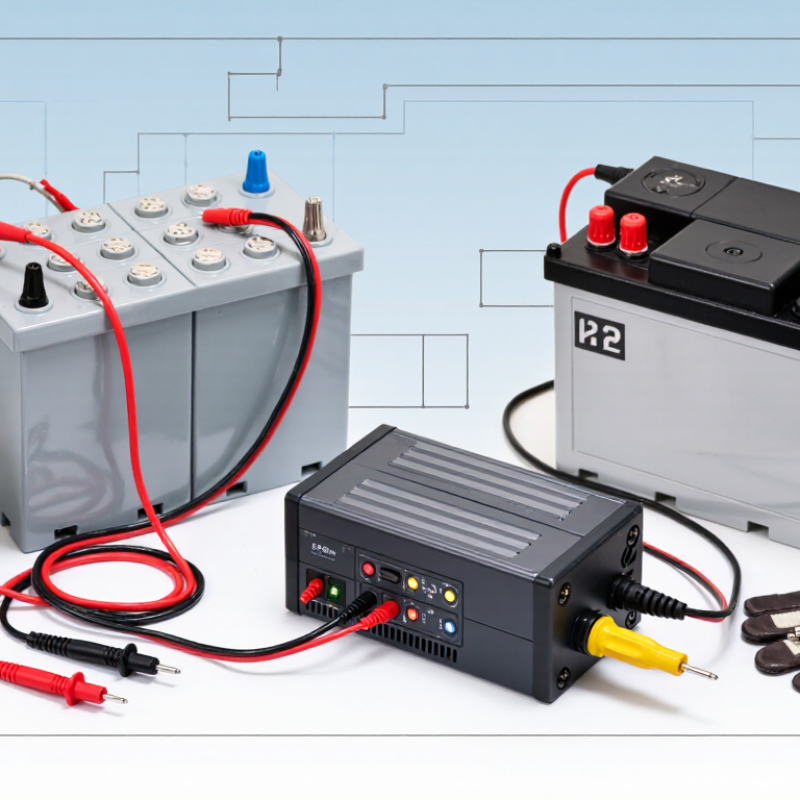
Understand How Two 6V Batteries Form a 12V Bank
Two 6V batteries make a 12V bank when connected in series: link the positive terminal of one battery to the negative terminal of the other. The two unconnected terminals become the bank’s positive and negative outputs. Their voltages add, but their amp-hour capacity does not. The U.S. Department of Energy’s Primer on Lead-Acid Storage Batteries (DOE-HDBK-1084-95) describes this series connection principle. For example, two 6V, 225Ah batteries form a nominal 12V, 225Ah bank, storing about 2.7kWh before accounting for usable-capacity limits. That distinction is easy to miss.
A 12V charger connects across the bank’s two free terminals, not across just one 6V battery. Check polarity carefully, and use batteries with matching chemistry, capacity, and condition. A weak battery can limit the pair, even when the charger shows a normal charge cycle. Small details matter.
Before charging, confirm that the charger’s profile suits the battery type and that its rated output matches the bank. Charging voltage can vary by chemistry and temperature, so a generic “12V” label alone is not enough. Keep the batteries ventilated and inspect cables for loose connections or corrosion. Even a clear wiring sketch can make this seem foolproof; in practice, mismatched batteries are an easy oversight.
Check Battery Chemistry, Capacity, and Condition
Before connecting a 12V charger, confirm that both batteries share the same chemistry. Two 6V lead-acid batteries in series provide 12V, but their amp-hour capacity does not add. The U.S. Department of Energy’s Primer on Lead-Acid Storage Batteries describes lead-acid cells as roughly 2V each; a 6V battery therefore contains three cells. Chemistry still matters: flooded, AGM, and gel batteries can require different charging limits. A charger set for the wrong profile may overcharge one battery, even when the pair reads 12V.
Match the batteries’ rated capacity, age, and condition as closely as possible. For example, two 6V, 200Ah batteries in series make a 12V, 200Ah bank, not 400Ah. Check for swollen cases, corrosion, leaks, or one battery that heats faster during charging. Small clues count. IEEE Std 1188-2005 uses 80% of rated capacity as a replacement threshold for certain stationary VRLA batteries; it is not a universal pass/fail rule for every battery type. Still, it shows why a voltage reading alone can mislead. If one battery is weak, the pair may charge unevenly. Test both separately, and follow their specifications; I would not assume two matching labels mean matching condition.
Connect the 12V Charger Across the Series Pair
With two 6V batteries connected in series, connect the 12V charger across the pair’s outer terminals. Attach the charger’s positive lead to the free positive terminal, and its negative lead to the free negative terminal. The midpoint cable joins the batteries; it is not a charger connection. The charger then sees a nominal 12V bank. Check polarity before switching it on. A quick meter check helps.
Use a charger whose charging profile matches the batteries’ chemistry and specifications; “12V” alone is not enough. Keep the batteries similar in type, capacity, and condition, since a weak battery can charge unevenly in a series pair. That detail matters. Follow the battery maker’s instructions, and stop if either battery becomes unusually hot, swollen, or damaged. For flooded lead-acid batteries, charge in a well-ventilated area and avoid sparks nearby. If the batteries use lithium chemistry, confirm that their battery-management system and charger are designed for series charging. It is easy to focus on the charger and overlook the batteries themselves. Check each battery’s voltage separately if charging seems abnormal.
5 Tips for Using a 12V Charger on Two 6V Batteries in Series
Chart: Two 6V batteries connected in series provide 12V nominal voltage. The chart shows nominal voltage, not the charger's charging voltage; the correct charging profile depends on battery chemistry.
- Connect the 12V charger across the two outer terminals of the series pair.
- Confirm the charger is designed for the batteries’ chemistry, such as flooded lead-acid, AGM, gel, or lithium.
- Check polarity and the battery manufacturer’s charging instructions before connecting the charger.
- Use batteries with compatible chemistry, capacity, age, and condition.
- Monitor charging and stop if a battery becomes unusually hot, swollen, or damaged.
Monitor Both Batteries During the Charging Cycle
When two 6V batteries are connected in series, a compatible 12V charger sees the pair as one 12V unit. But the batteries may not share the charge evenly. Differences in age, capacity, or condition can cause one battery’s voltage to rise faster. The total reading can look normal while one battery is already near its limit.
Tip: Check each battery separately during charging. With a suitable multimeter, measure across the posts of each battery and compare the readings. Follow the battery maker’s charging limits, and check again as charging continues. Keep the probes steady. Small details matter.
Stop charging if either battery exceeds its specified voltage or becomes unusually hot, swollen, or damaged. Turn off and unplug the charger before changing connections. Use batteries of the same chemistry, capacity, and similar age; a mismatched pair can be hard to balance. For lithium batteries, confirm that the pack’s battery-management system supports series charging and that the charger matches its requirements. A quick glance at the combined voltage is not enough. It is easy to miss a growing difference. If readings seem inconsistent, pause and consult the battery documentation or a qualified technician.
Disconnect Safely and Check Each Battery’s Charge Level
Before connecting a 12V charger, switch it off and unplug it from the outlet. Turn off the equipment, too. Check the charger instructions and confirm it matches the batteries’ chemistry. Wear eye protection, keep the area ventilated, and inspect both cases for cracks, leaks, or swelling. Don’t charge a damaged battery.
With the charger disconnected, use a multimeter to measure each 6V battery directly across its own terminals. Note the readings separately; the pair’s combined voltage can hide an imbalance. Check that the positive and negative leads are correctly identified before attaching the charger. Keep tools away from both terminals at once. A brief slip can cause a short circuit.
Connect the charger leads as its manual specifies, then power it on. Watch each battery for unusual heat, swelling, or a sharp smell, and stop if anything seems wrong. A compatible 12V charger treats the pair as one 12V bank, but it cannot correct every mismatch. If one battery’s reading is much lower, don’t assume another charging cycle will fix it. I’m tempted to skip individual checks when the combined reading looks normal; that shortcut can miss the problem.
5 Tips for Using a 12V Charger on Two 6V Batteries in Series? - Disconnect Safely and Check Each Battery’s Charge Level
| Tip |
What to Do |
Why It Matters |
Safety Check |
| 1 |
Confirm that the batteries are connected in series: the positive terminal of one battery connects to the negative terminal of the other. The two remaining terminals form a nominal 12V pack. |
Two nominal 6V batteries in series add their voltages. The pack’s amp-hour capacity remains the same as that of one battery, assuming matched batteries. |
Check the wiring diagram and battery labels before connecting the charger. Do not rely on cable color alone. |
| 2 |
Use a 12V charger that is designed for the batteries’ chemistry, such as lead-acid or lithium, and follow the battery maker’s charging instructions. |
Battery chemistries require different charging profiles. A charger with the wrong profile can cause poor charging or damage. |
Verify both the charger’s voltage setting and chemistry mode before connecting it. |
| 3 |
Before charging, switch off and unplug the charger. Connect its positive lead to the pack’s positive terminal and its negative lead to the pack’s negative terminal, following the charger instructions. |
Connecting with the charger de-energized helps reduce the risk of sparks, accidental short circuits, and incorrect connections. |
Keep tools and loose metal away from battery terminals. Work in a well-ventilated area and use appropriate eye protection. |
| 4 |
To check each battery, unplug the charger first. Use a suitable voltmeter across the positive and negative terminals of each battery, taking care not to bridge terminals with the probes. |
A total pack reading can hide an imbalance: one battery may be more charged, weaker, or faulty than the other. |
For a meaningful comparison, follow the battery maker’s guidance on rest time and voltage interpretation. Voltage alone may not accurately show state of charge for every chemistry. |
| 5 |
Stop charging if a battery becomes unusually hot, swells, leaks, smells abnormal, or behaves differently from its mate. Have the batteries and connections checked before charging again. |
Uneven condition or a poor connection can lead to unsafe charging and reduce battery life. |
Do not disconnect or reconnect battery cables while the charger is operating. Turn off and unplug the charger before changing connections. |
Important: Charge the series pair as a 12V pack only when the charger and both batteries are compatible with that setup. Follow the battery and charger manufacturers’ instructions; do not charge damaged batteries.
Conclusion
Can a 12V charger be used on two 6V batteries in series? Yes, when the batteries are connected correctly in series, their combined nominal voltage is 12V, so a compatible 12V charger can charge the pair across the bank’s positive and negative terminals. Before charging, confirm that both batteries have the same chemistry and compatible capacity, and check that neither is damaged or unusually discharged. The charger’s settings must suit the battery chemistry.
During charging, monitor the bank and, where possible, each battery individually. A large difference in voltage, unusual heat, or other signs of trouble may indicate an imbalance or fault; stop charging and investigate rather than continuing unattended. When charging is complete, switch off or unplug the charger before disconnecting its clamps, following the charger’s instructions. Then check each battery’s charge level separately to make sure both have charged evenly. Regular individual checks can help identify problems early and support reliable performance.

 E-Tronde Charger